
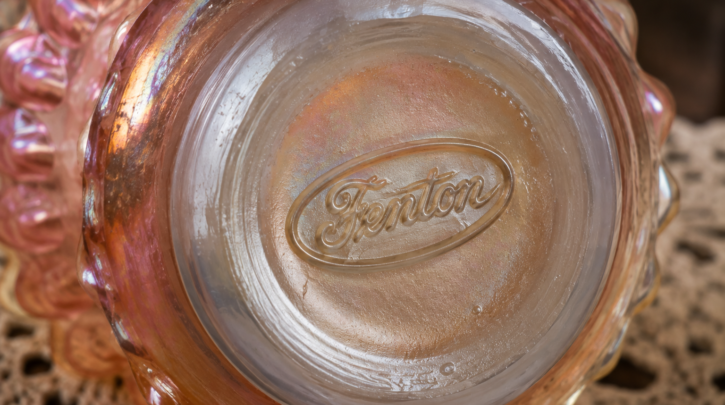

Fenton’s mark history is genuinely simple to summarize but easy to misunderstand: the company left most of its output unmarked for its first six-plus decades, which means the absence of a mark tells you almost nothing on its own — it’s actually the norm for a huge share of genuine, desirable Fenton glass.
Before 1970: Mostly Unmarked
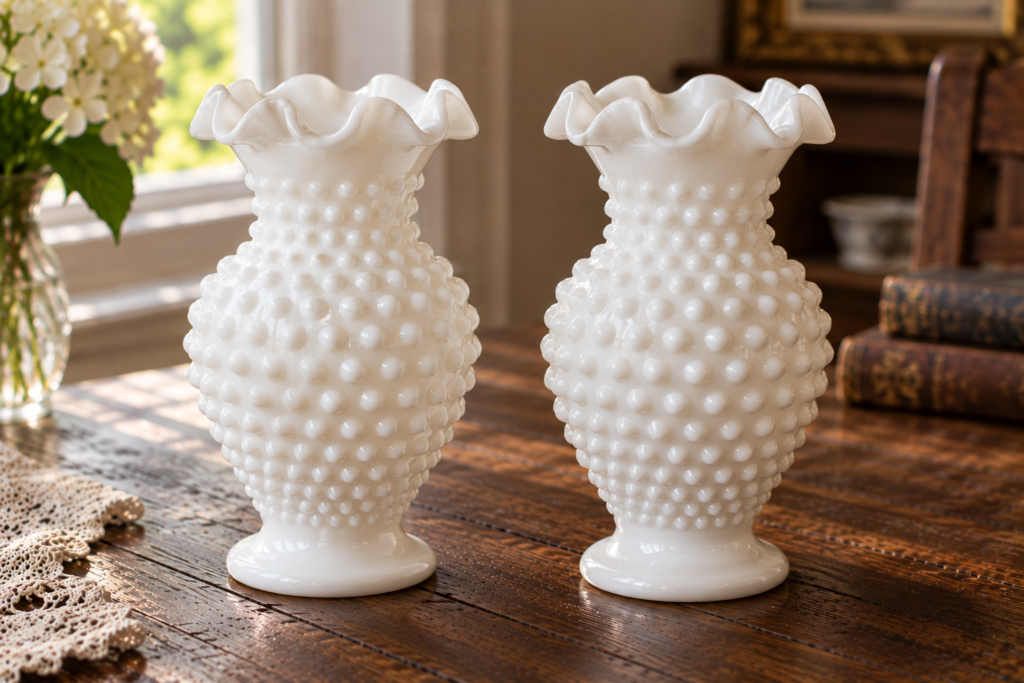
For the majority of Fenton’s early and mid-century production, including classic carnival glass and the early years of the Hobnail milk glass boom, pieces left the factory with no maker’s mark at all. This is exactly why pattern and color recognition matter so much for dating and authenticating older Fenton pieces, since a missing mark simply isn’t useful evidence one way or the other for this era; see our identification guide for the broader approach this requires.
1970 Onward: The Oval Script Logo
Starting in 1970, Fenton introduced a raised oval mark with “Fenton” in script, molded directly into the glass, and this became the company’s standard mark from that point forward. Finding this mark on a piece is a reliable indicator that it was made in 1970 or later — genuinely useful information, since it immediately rules out the much larger and more complex pre-1970 unmarked universe.
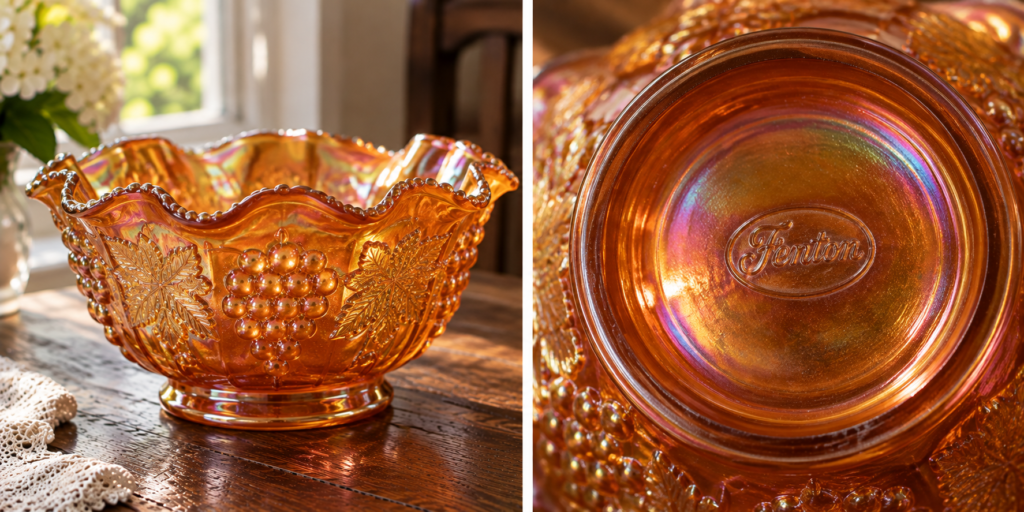
The Mark Evolved Over the Decades
Fenton’s oval logo went through design changes over the following decades, and in some later years the company added supplementary numbers or codes alongside the main logo that can help narrow down a more specific production date range. Because these variations are genuinely detailed collector-level knowledge, cross-referencing a specific mark variation against a dedicated Fenton mark reference or collector club resource gives far more precise dating than a general overview like this one can responsibly provide.
The 2011 Cutoff
Fenton closed to general production in 2011, which functions as a hard ceiling for what most collectors mean by “vintage” or “collectible” Fenton in the traditional sense — pieces made under the smaller, family-continued operations after that point are a genuinely different category worth treating separately from the main factory’s historical output.
Marks Aren’t a Complete Authentication Tool
A genuine Fenton mark is good supporting evidence, but it isn’t a substitute for checking pattern, color, and overall quality against known references — marks can be present on pieces of varying quality and rarity, so a marked piece isn’t automatically valuable just because the mark confirms the maker; see our value guide for the other factors that actually drive price.
A Practical Dating Workflow
- No mark, but matches a known early pattern and color: likely pre-1970
- Oval ‘Fenton’ script logo present: 1970 or later
- Logo plus a number or date code: check a dedicated mark reference for the specific year range
- Any piece from after 2011: treat as a separate, smaller-scale production category
When Marks and Pattern Don’t Match
If a piece’s mark suggests one era but its pattern or color seems associated with a different production period, that mismatch is worth investigating further rather than dismissing — it could reflect a later reissue of an older pattern, which is common enough in Fenton’s history to be a real, ordinary occurrence rather than automatically a sign of something deceptive.
Stickers and Paper Labels
Beyond the molded glass mark, Fenton also used paper stickers and foil labels on many pieces over the decades, which unfortunately were designed to be removed and rarely survive the decades of handling and washing that separate a piece from its original sale. A piece missing its original sticker isn’t unusual or suspicious — it’s simply the normal outcome of a label never meant to be permanent in the first place.
Why This Mark History Is Unusually Collector-Friendly
Compared to some other makers where marks are inconsistent, easily forged, or simply undocumented, Fenton’s relatively clean before-1970 versus after-1970 split gives collectors a genuinely useful, well-documented reference point most other glass companies don’t offer nearly as clearly, even if the pre-1970 era still demands real pattern knowledge to date with confidence.
Documenting What You Find
Photographing a mark clearly, alongside the piece’s overall pattern and color, creates a useful record for future reference or for sharing with a collector club or specialist if a more precise dating opinion is needed later — a habit worth building from the very first piece rather than only starting once a collection feels more serious.
That small habit, kept up consistently, turns a scattered collection into a genuinely organized reference over time.