
Milk glass collecting organizes around a smaller set of patterns and forms than something like Depression glass, but a few categories — Hobnail above all, plus the entire sub-hobby of covered animal dishes — account for most of what collectors actively pursue.
Hobnail: The Signature Pattern
Hobnail features a field of small, raised, rounded bumps covering a piece’s surface, and it’s so closely associated with Fenton’s mid-century production that for many people, Hobnail and milk glass are essentially synonymous. Fenton produced Hobnail across an enormous range of shapes — vases, bowls, candy dishes, lamps — which gives Hobnail collectors a huge amount of variety to pursue within a single, easily recognizable pattern.
Covered Animal Dishes: A Collecting Category of Its Own
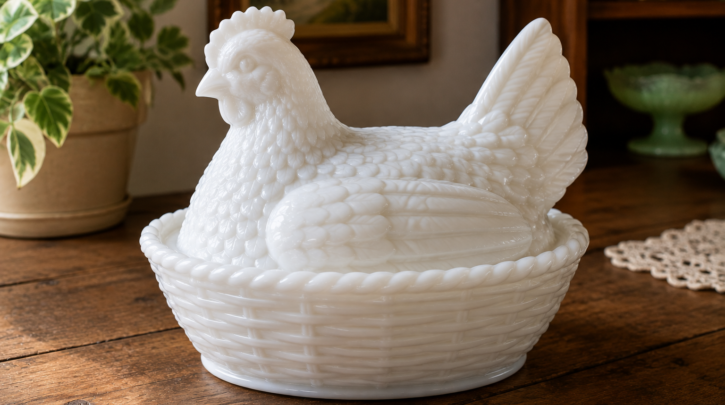
Covered dishes shaped like animals, with a removable lid forming the animal’s body sitting atop a base dish, are among the most iconic and widely collected milk glass forms — and the hen sitting on a nest is by far the classic, most instantly recognizable example, produced by numerous manufacturers over decades. Beyond hens, rabbits, cats, dogs, ducks, and turkeys all appear in this covered-dish format, and dedicated collectors sometimes focus on this animal-dish niche specifically rather than milk glass as a whole.
Why Hen-on-Nest Dishes Are So Heavily Reproduced
Because hen-on-nest dishes have remained continuously popular for well over a century, they’ve been produced, discontinued, and reproduced repeatedly by multiple companies, which makes this specific form one of the trickiest in the entire milk glass category to date confidently. Comparing weight, glass clarity, and mold-seam sharpness against verified examples matters more here than almost anywhere else in milk glass collecting.
Lace Edge and Openwork Patterns
Patterns featuring pierced, lace-like openwork edges or borders were especially popular in decorative pieces and are closely associated with Westmoreland’s reputation for intricate detail work, adding a more delicate, ornate look distinct from Hobnail’s simple raised-bump texture.
Grape and Vine Motifs
Grape clusters and vine patterns, molded in relief against the opaque white background, appear across multiple makers and eras, often on serving pieces and covered dishes, and represent one of the more traditional decorative motifs carried over from earlier pressed-glass styles into milk glass production.
A Quick Pattern Reference
| Pattern/Form | Most Associated Maker | Era |
|---|---|---|
| Hobnail | Fenton | Mid-century (1950s-60s) |
| Hen on nest | Multiple makers | Victorian through present |
| Lace edge/openwork | Westmoreland | Victorian and mid-century |
| Grape and vine | Multiple makers | Victorian through mid-century |
Choosing a Focus
New collectors often do better narrowing in on one pattern or form — Hobnail, or animal dishes specifically — rather than trying to collect milk glass broadly from the start, since depth in one area builds identification skill faster than spreading attention thin across the whole category; see our identification guide for the general skills that apply no matter which focus you choose.
Displaying a Themed Collection
Because patterns like Hobnail and animal dishes are so visually distinctive, a themed collection — say, hen-on-nest dishes in different sizes and colors, or a shelf of Hobnail vases — often makes for a more cohesive, visually satisfying display than a mixed assortment of unrelated milk glass pieces, which is worth keeping in mind when deciding what direction to take a growing collection.
Cross-Referencing Patterns With Maker Marks
Where a piece does carry a maker’s mark, cross-referencing that mark against the pattern and form helps confirm identification and catch cases where a mark and pattern don’t line up with known production history, which can be a useful red flag; see our history and makers guide for which companies are associated with which signature patterns.
Mixing Patterns Within a Single Display
Even collectors who focus primarily on one pattern often keep a few pieces from other forms as accent pieces — a single hen-on-nest dish among a larger Hobnail collection, for instance — which is a reasonable way to enjoy the category’s broader range without diluting the focus that makes a themed collection feel cohesive.
Learning to Read a Piece’s Overall Story
Pattern, form, color, and any marks together tell a fuller story than any single clue alone — a hen-on-nest dish in an unusual color with crisp mold detail and a period-appropriate maker’s mark tells a very different story than a common white one with soft, blurry detail, even though both start from the exact same recognizable shape.
Taking the time to notice all of these details together, rather than stopping at the first recognizable feature, is what separates a confident identification from a guess.