
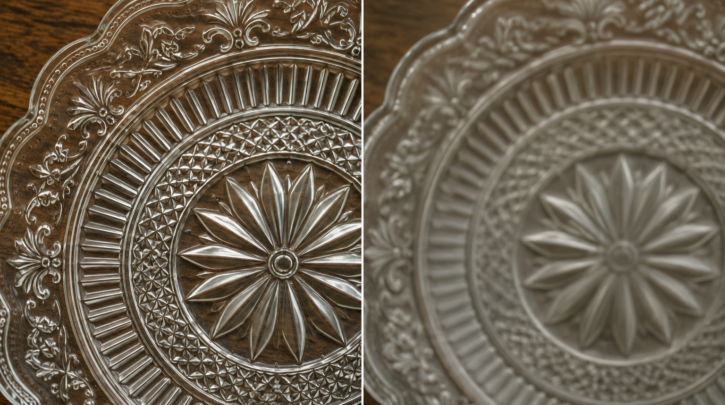

Every collectible glass category on this site has some level of reproduction or reissue activity, and while the specific patterns differ, the underlying detection principles are remarkably consistent — which means learning them once genuinely pays off across every category you might collect.
Why Reproductions Exist at All
Sustained collector demand for out-of-production, popular designs creates a real financial incentive to keep making similar-looking glass, and this happens in two genuinely different ways: unrelated companies copying a popular design, and original manufacturers reissuing their own historic patterns years or decades later. Both scenarios show up across the categories covered on this site, from Depression glass’s Recollection reissue to Fenton’s continued production of its own historic lines; see our Depression glass reproductions guide for a detailed example of the first scenario.
Blurred Mold Detail: The Most Common Tell
Many reproductions are cast from an existing original piece rather than from the manufacturer’s actual original mold tooling, a process that loses fine detail with each generation — the result is noticeably softer, less crisp pattern definition compared to a genuine piece pressed from the original mold, even when color and overall shape look right at a glance.
Weight and Thickness Anomalies
Reproductions sometimes run heavier, thicker, or occasionally lighter than documented originals, reflecting differences in the specific manufacturing process used decades later — not a universal rule across every reproduction, but a useful supporting data point when something about a piece’s heft doesn’t match expectations for its claimed pattern and era.
Color Combinations That Don’t Match History
Across every category on this site, a piece in a color that pattern was never documented as being originally produced in is one of the clearest reproduction red flags available — this single check comes up repeatedly whether you’re looking at Depression glass, carnival glass, or vintage Pyrex; see our carnival glass colors guide for how this plays out in a category with especially well-documented color-to-pattern relationships.
Marks Help, But Only Sometimes
Some reproductions carry an intentional distinguishing mark, but many don’t, and marks can wear away or go unnoticed by sellers who don’t know what they’re looking at — relying on marks alone is genuinely risky across every category on this site; see our Fenton marks guide for how even a well-documented mark system still requires cross-referencing against pattern and color.
Reproductions Aren’t Inherently Bad
A reproduction piece can still be attractive, functional, and worth owning — the issue is only ever paying original-piece prices for one without realizing what it actually is, or unknowingly reselling one as an authentic original. Honest representation matters far more than avoiding reproductions altogether.
When the Stakes Are High Enough
For any purchase where the price assumes an authentic, rare original — rather than a common piece or an acknowledged reproduction — getting a second opinion from an experienced collector or a professional appraisal is worth the cost before committing; see our appraisal guide for how that process works across every category on this site.
Building a Personal Reference Library
Photographing verified genuine pieces you own or handle, alongside notes on pattern, color, weight, and any marks, builds a personal reference that becomes genuinely useful for evaluating future finds — this habit pays dividends across every category on this site, not just whichever one you started with.
A Skill Worth Developing Early
The sooner a collector internalizes these general reproduction-detection principles, the less expensive the inevitable early learning mistakes tend to be — practicing on lower-stakes, inexpensive pieces builds the same skills that later protect a much larger purchase.
Trusting the Process as You Go
It’s normal to feel less than fully confident early on, especially given how convincing some reproductions have become — that uncertainty fades with repeated practice, and even experienced collectors occasionally get surprised, which is simply part of collecting rather than a sign anything is wrong with your approach.
What matters most is staying curious and careful in roughly equal measure, which is really the whole philosophy behind every guide on this site.