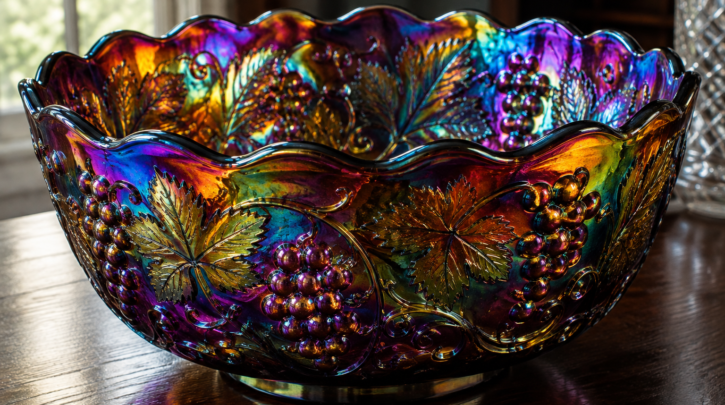

Four American glass companies — Fenton, Northwood, Imperial, and Millersburg — are collectively known among collectors as the “Big Four,” and together they account for the large majority of classic-era carnival glass that collectors actively pursue today.
Fenton Art Glass
Founded in 1905, Fenton is frequently credited as a major force in popularizing carnival glass in its original era, producing an especially wide range of colors and patterns, including well-known peacock-motif designs. Fenton also continued producing glass, including new carnival glass lines, for decades afterward, which makes distinguishing classic-era Fenton from later production genuinely important; see our Fenton identification guide for how Fenton’s mark history helps with dating.
Northwood Glass
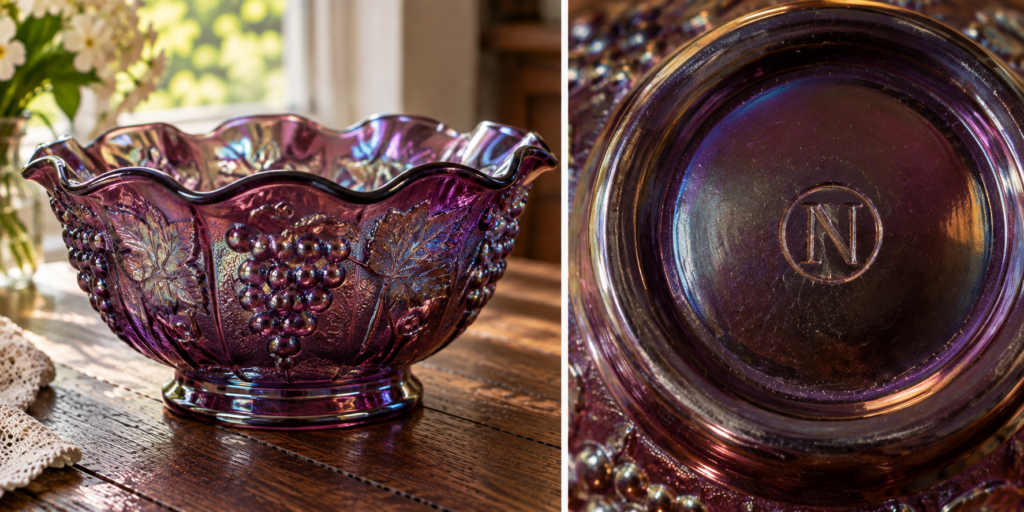
Northwood, led by Harry Northwood, is closely associated with the iconic Grape and Cable pattern and is one of the few classic-era makers to mark a meaningful share of its output, using a distinctive underlined “N” inside a circle. Northwood is also strongly linked to some of the rarer colors, including aqua opalescent and ice colors, which adds to the brand’s strong collector following.
Imperial Glass
Imperial produced its own widely collected patterns, including Imperial Grape, and is particularly associated with the smoke and clambroth colorways covered in our colors guide. Like Fenton, Imperial continued producing glass well beyond the classic era, including later reissues, which again makes era identification a meaningful part of accurately valuing an Imperial piece.
Millersburg Glass
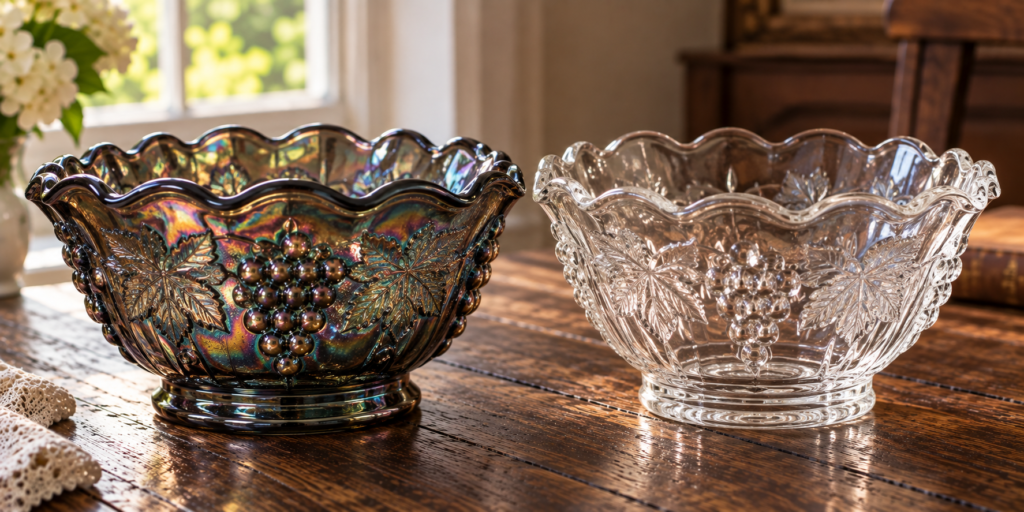
Millersburg operated for only a few years, roughly 1909 to 1911, before financial difficulties ended its run — and that short, ill-fated production window is exactly why Millersburg pieces are considered especially rare and desirable today. Millersburg’s glass is sometimes noted for an especially rich, deep iridescent finish, occasionally called “radium” finish by collectors, that stands out even among other classic-era makers.
Other Notable Makers
Beyond the Big Four, Dugan/Diamond Glass, the U.S. Glass Company, Cambridge Glass, and Westmoreland Glass all produced carnival glass during the classic era in smaller volumes, and pieces from these makers can be genuinely valuable, particularly in less common patterns or colors, even though they don’t carry the same broad collector recognition as the Big Four.
Marks Are Inconsistent Across Makers
Outside of Northwood’s relatively consistent “N” mark, most classic-era carnival glass left the factory unmarked, which is why pattern recognition remains the primary identification tool across the category rather than hunting for a maker’s mark that, for most pieces, simply isn’t there; see our identification guide for the broader identification approach this makes necessary.
Contemporary Production From the Same Companies
Because Fenton and Imperial both continued operating and producing carnival-style glass long after the classic era ended, some later pieces carry the same company name as a highly valuable classic-era piece while being worth a fraction of the price — checking pattern, color, and, where available, dating clues specific to each company is essential rather than assuming a recognizable maker name alone guarantees classic-era value.
Why Maker Knowledge Pays Off
Learning to recognize a handful of signature patterns and colors from each of the Big Four gives a collector a genuine head start over relying on guesswork or a seller’s own description, since sellers unfamiliar with the hobby often mislabel pieces without any intent to deceive — they simply don’t know the difference between a classic Northwood piece and a later reissue that happens to share the same maker name.
Researching a Specific Maker Further
Once a maker’s core patterns and colors feel familiar, dedicated collector club resources and maker-specific reference guides offer far more depth than any general overview can, including detailed mold variations and production timelines that help pin down exactly when a specific piece was likely made.
Why the Big Four Framework Is Worth Learning First
Focusing on four makers rather than trying to absorb every smaller producer at once gives a new collector a manageable, high-payoff starting point, since these four account for such a large share of what actually circulates in the market. Once Fenton, Northwood, Imperial, and Millersburg feel genuinely familiar, expanding into the smaller makers becomes a much easier, incremental step rather than an overwhelming amount of information all at once.
Most experienced collectors describe exactly this progression — four makers first, then a widening circle of smaller producers as confidence builds.