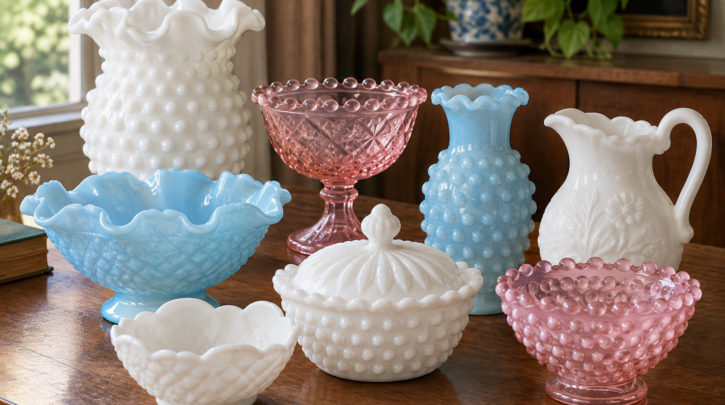

Common mid-century Hobnail pieces remain widely available and affordable, which sometimes surprises people who assume all antique glass carries real value — genuine value in milk glass concentrates in specific eras, makers, colors, and forms rather than the category as a whole.
Era: Victorian vs. Mid-Century
Because far fewer Victorian-era pieces survive compared to the enormous mid-century production run, genuine Victorian milk glass generally commands higher prices than equivalent mid-century pieces, though exceptions exist for particularly rare or desirable mid-century forms; see our history and makers guide for how these two production eras differ.
Maker Reputation
Westmoreland’s reputation for detailed, high-quality work generally supports stronger prices than equivalent common Fenton Hobnail pieces, even though Fenton remains the more historically dominant and widely recognized milk glass producer overall.
Color Beyond White
While white is by far the most iconic milk glass color, opaque milk glass was also produced in blue, pink, black, and green, and pieces in these less common colors typically command a real premium over equivalent white pieces, simply due to lower production volume.
Rarity of Form
Within covered animal dishes specifically, the classic hen on a nest is common enough to remain affordable in most cases, while less common animal forms — certain rabbit, duck, or turkey designs, or unusual figural pieces beyond the animal-dish category entirely — can command meaningfully higher prices due to lower production numbers; see our patterns guide for the range of forms this covers.
Condition Matters Even More for White Glass
Chips and cracks show up starkly against opaque white glass in a way they’re sometimes less visually obvious on colored or clear glass, and collectors are generally unforgiving about damage on milk glass specifically — even minor chipping on an otherwise desirable piece can significantly reduce what a serious collector is willing to pay.
The Reproduction Discount
Because reproduction and ongoing legitimate re-production are both so common in milk glass, particularly for Hobnail and hen-on-nest forms, confirmed reproductions or pieces of uncertain age sell for considerably less than confidently dated originals, even when the reproduction is attractive and well-made in its own right.
Checking Current Prices
As with every category on this site, checking recent completed sales gives a far more accurate picture of current value than an older printed price guide, since collector demand and pricing shift over time.
Check current milk glass listings and completed sales Search milk glass on eBay
When a Piece Seems Unusually Valuable
For a piece that seems like it could be genuinely rare — an unusual animal form, a colored piece, or something that seems distinctly Victorian rather than mid-century — a professional appraisal is worth the cost before selling or insuring it; see our appraisal guide for how that process works.
Value Isn’t the Only Reason to Collect
A shelf of common Hobnail pieces, even if individually inexpensive, can still be a genuinely satisfying collection to build and display — milk glass’s broad affordability is part of what makes it such an accessible entry point into glass collecting generally, not a knock against the category.
Assessing an Inherited Collection
For a box or cabinet of milk glass inherited without any record of what it is, sorting first by pattern (Hobnail versus other forms), then by color, then by any visible maker’s marks, gives a quick, organized starting point before deciding which pieces, if any, are worth further research or a professional look.
A Grounded Way to Think About a Collection’s Worth
Most inherited or accumulated milk glass collections turn out to be a mix of a large number of common, modestly valued Hobnail-era pieces and, occasionally, one or two standout items — a colored piece, an unusual animal form, or something genuinely Victorian — worth researching more closely. Expecting that realistic mix, rather than assuming either extreme, makes the assessment process considerably less stressful.
Patience Pays Off in Milk Glass Specifically
Because so much milk glass remains inexpensive and widely available, there’s rarely urgency to buy or sell quickly — taking time to research a piece properly before committing to a price, in either direction, tends to serve collectors better than rushing a transaction based on an initial impression alone.
A little patience costs nothing and consistently leads to better outcomes than a rushed decision made under pressure.