
Antique glass has two sourcing considerations that don’t apply the same way to furniture, ceramics, or paper collectibles: it breaks, and a big part of authenticating it — specifically confirming genuine uranium content under UV light — only really works in person. Every venue in this guide is weighed against those two factors first, price and selection second, because a great deal on a fragile piece that arrives in shards, or a “glows under blacklight!” listing you can’t actually verify, isn’t the deal it looks like.
Why Glass Shopping Is Different: Breakage and Verification
Fragility is the more obvious risk. Even carefully packed glass can crack or chip in transit, and a hairline crack from shipping damage can be difficult to distinguish from age-related damage once a piece arrives — which matters if you’re trying to assess whether a flaw is original to the piece’s history or brand new. That risk simply doesn’t exist when a piece goes straight from a table into your hands.
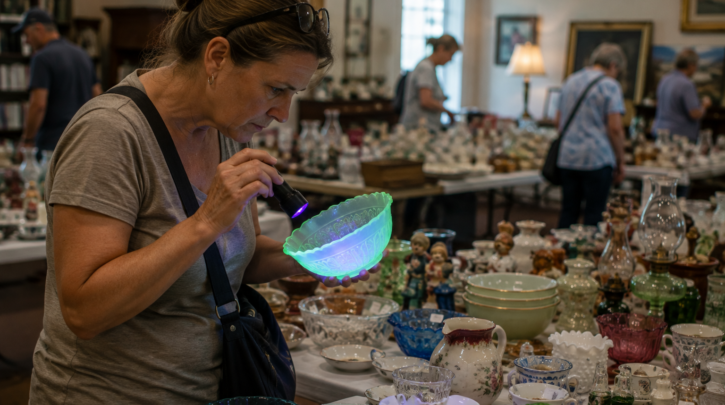
The second risk is specific to this category and easy to overlook: authenticating uranium glass — often sold as vaseline glass — depends on how it responds under a 365nm UV blacklight, and that’s something no listing photo can prove. A seller can caption a photo “glows neon green under blacklight,” but a static image of a glow, real or edited, isn’t the same as watching a piece respond to a blacklight in your own hands. For what genuine fluorescence should actually look like, see our uranium and vaseline glass guide. In practice, this means uranium glass is one of the clearest cases where an in-person venue has a real, structural advantage over buying sight-unseen — not just a nice-to-have, but the only way to actually confirm what you’re getting before you pay for it.
With those two considerations as the backdrop, here’s how the major venues stack up.
Estate Sales
Estate sales often offer the best original pricing and a real chance at undiscovered finds, since pricing is frequently set by someone without deep collector knowledge of what a specific piece is worth. Because you’re handling pieces directly, you can inspect for shipping-proof condition and, if you bring a blacklight, test uranium glass on the spot — an advantage no online listing can match. The tradeoff is that early arrival matters enormously for the best pieces, and cash is often preferred or required on-site.
Antique Malls and Multi-Dealer Shops
Antique malls offer convenient browsing across many dealers’ inventory in one place, with clearly marked prices, though those prices typically run higher than estate sale pricing since they include dealer markup. Like estate sales, you’re handling the glass directly — no shipping risk, and any uranium glass on the shelf can be tested with a blacklight before you commit. The advantage of an antique mall specifically is being able to ask a knowledgeable dealer questions directly, which estate sales rarely offer.
Flea Markets
Flea markets are a genuine mixed bag — great deals and honest mistakes by sellers happen alongside occasional misidentified reproductions sold as originals, whether intentionally or through simple seller ignorance. This is another in-person venue where a blacklight test earns its keep fast: a seller who genuinely believes their green glass is uranium glass, or is passing off a reproduction as one, gets sorted out in seconds rather than after a purchase. Bringing solid identification knowledge matters more here than almost anywhere else; see our reproduction guide for the general detection framework worth having ready.
Online Marketplaces
Online marketplaces offer by far the largest selection and the ability to search for specific patterns or pieces directly. But this is exactly where both category-specific risks stack up: you’re buying based on photos and a seller’s description rather than handling a piece yourself, which adds real risk both for shipping damage to fragile glass and for authenticity claims — like uranium content — that a photo simply can’t verify. A listing photo showing a glow under blacklight could be genuine, staged with a colored filter, or lifted from a different piece entirely, and there’s no way to tell from the buyer’s side of the screen. If a listing’s main selling point is a claimed UV glow, treat that claim as unconfirmed until the piece is in your hands, and factor a real return policy into the price you’re willing to pay.
Browse current antique glass listings Search antique glass on eBay
Auctions
Both in-person and online auctions can produce excellent prices for a patient bidder, or lead to overpaying in the excitement of active bidding. In-person auctions carry the same verification advantage as estate sales and antique malls — you can inspect condition and test fluorescence before bidding — while online auctions carry the same photo-only limitations as any other online marketplace. Setting a firm maximum price before bidding begins, and sticking to it regardless of how the bidding unfolds, is the single most useful discipline for auction buying either way.
Collector Clubs and Specialty Shows
Dedicated collector club events and specialty glass shows connect buyers directly with knowledgeable sellers who specialize in a specific category, often the best source for rare or pattern-specific pieces that rarely surface through general channels. These shows are also where you’re most likely to find fellow collectors carrying blacklights as a matter of course, and dealers who expect and welcome the question. The tradeoff is a smaller, more specialized selection compared to a general marketplace.
Replacing a Piece From an Existing Set
For the specific task of finding a piece to complete or replace part of an existing set, a specialist retailer with a large cataloged inventory of patterns is often faster and more reliable than searching general marketplaces piece by piece. Since replacement pieces ship to you, ask about the seller’s packing method for fragile items and their breakage policy before you buy.
Search for a matching pattern to complete a set Search patterns at Replacements, Ltd.
General Buying Tips
- Bring a 365nm UV blacklight to any in-person venue if uranium or vaseline glass authenticity is a question — it’s the one verification step that genuinely can’t be done through a screen.
- Inspect condition thoroughly in person when possible, including running a finger along edges to feel for chips light might not show clearly.
- Ask about return policies before buying anything expensive sight unseen, especially fragile pieces bought online where shipping damage is a real possibility.
- Research a pattern or maker before a big purchase rather than trusting a seller’s description alone.
- If a listing photo claims a UV glow, treat it as a lead worth investigating in person or after arrival, not as confirmed authentication.
Budgeting for the Hunt
Setting a rough budget before heading out to an estate sale or antique mall, and treating it as a genuine limit rather than a loose guideline, helps avoid the common pattern of overspending on impulse finds that seemed irresistible in the moment but don’t actually fit a collection’s focus.
Building Relationships With Dealers
A dealer who gets to know your specific collecting interests over repeated visits will often set aside pieces or offer a heads-up before something goes on the general sales floor. It’s also a relationship where trust runs both ways: a dealer who’s seen you carry a blacklight and ask good questions will generally be straighter with you about a piece’s history than a one-time buyer. This kind of relationship takes time to build but can meaningfully improve access to good pieces at antique malls and shows over the long run.
Timing Your Shopping
Estate sales typically offer the best selection on the first day but often reduce prices on later days to clear remaining inventory — a genuine tradeoff between selection and price that’s worth weighing based on whether you’re chasing something specific or open to whatever turns out to be a good value.
Neither approach is wrong — it depends entirely on whether you’re hunting for something specific or simply enjoying the process of seeing what turns up. What matters more than timing, in the end, is matching the venue to the piece: save fragile, high-stakes, or uranium-glass purchases for venues where you can inspect and test before you buy, and reserve online marketplaces for pieces where a bad guess costs you little.