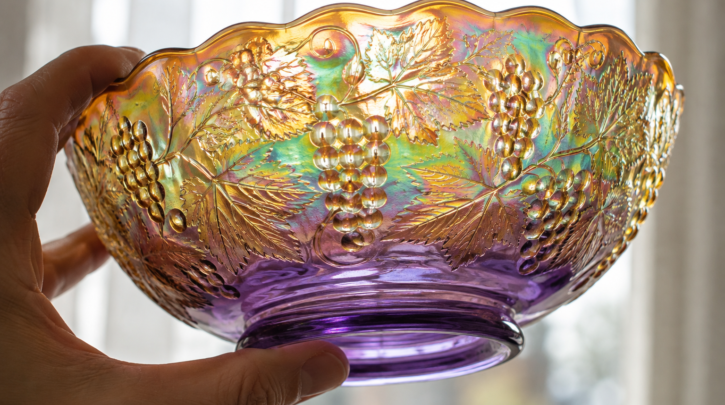

The single most important thing to understand about carnival glass color is that there are two separate things going on: the iridescent surface finish that shimmers and shifts, and the base color of the glass underneath it — and it’s the base color, not the shimmer, that does most of the work in determining rarity and value.
How to Check Base Color
Base color is easiest to see in areas where the iridescent coating is thinnest or was applied more lightly, often around the foot or base of a piece, or by holding the piece up to strong light and looking through the glass rather than at its reflective surface. This takes a little practice, since the iridescent finish can make base color genuinely hard to judge at a quick glance.
Marigold: The Common Default
Marigold — an orange-amber iridescent finish over clear glass — is by far the most common carnival glass color, since it was the cheapest and easiest to produce at the mass-market scale carnival glass was originally sold at. This high production volume is exactly why marigold pieces generally command the lowest prices within any given pattern, even in excellent condition.
Purple (Amethyst), Green, and Blue
Purple, often called amethyst, along with green and blue, were all produced in meaningful quantity across most major makers and sit in the middle of the value range — more desirable than marigold, but still common enough that a typical piece in one of these colors remains affordable for most collectors.
Ice Blue and Ice Green
Ice blue and ice green are pale, delicate pastel tones produced in smaller quantities than the core colors, mainly by Imperial and Northwood, and they command a real premium over the more common transparent colors thanks to that scarcity.
Red: The Rarest Classic-Era Color
Red is widely considered the rarest and most valuable base color in classic-era carnival glass, since achieving a true red required a more difficult and expensive glass formula than the other colors — red pieces were produced in much smaller numbers as a result, and they consistently command the highest prices of any base color across nearly every pattern they appear in.
Aqua Opalescent
Aqua opalescent combines an aqua base color with an opalescent white edge effect, most closely associated with Northwood, and it’s another standout-rare color that draws serious collector premiums, particularly in well-known patterns like Grape and Cable.
Smoke and Clambroth
Smoke, a grayish tone most associated with Imperial, and clambroth, a pale, almost milky light color, are less common and less immediately eye-catching than the vivid colors above, but they’re genuinely scarce and hold real value among collectors who specifically seek out these more muted colorways.
A Quick Value-Tier Reference
| Base Color | Relative Rarity | General Value Tier |
|---|---|---|
| Marigold | Very common | Lowest |
| Purple, green, blue | Common | Mid |
| Ice blue, ice green | Uncommon | Higher |
| Smoke, clambroth | Scarce | Higher |
| Aqua opalescent | Rare | Very high |
| Red | Rarest | Highest |
Why This Matters More Than the Shimmer Itself
Two pieces in the same pattern with equally beautiful iridescent shimmer can be worth wildly different amounts purely based on the base color underneath, which is exactly why learning to check base color specifically matters more than judging a piece by how impressive its surface finish looks at first glance; see our value guide for how color combines with pattern and shape to determine overall worth.
Iridescence Quality Also Varies
Beyond base color, the quality of the iridescent finish itself — how rich, multicolored, and evenly applied it is — varies between makers and even between individual pieces from the same maker, and a particularly vibrant, well-executed finish can add real appeal even within a common base color. Millersburg’s glass, for example, is often noted for an especially deep, rich finish that stands out even in otherwise common colors.
Photographing Carnival Glass Color Accurately
The same iridescent piece can look dramatically different depending on lighting angle and source, which makes carnival glass genuinely tricky to photograph accurately for an online listing or price comparison — multiple photos from different angles and light sources give a far more honest representation than a single shot that happens to catch a particularly flattering shimmer.
If you’re comparing a piece against an online reference photo before buying, keep this variability in mind rather than rejecting a genuine piece just because it doesn’t match one particular photo’s lighting exactly.
A short video, panned slowly under a couple of different light sources, often communicates a piece’s true color and shimmer far better than any single still photo ever could.