
Milk glass is opaque glass, most commonly white, and while the style traces back centuries to European glassmaking, the milk glass most American collectors encounter today falls into two distinct eras — Victorian decorative pieces and a huge mid-20th-century revival — with real identification differences between them.
Two Very Different Collecting Eras
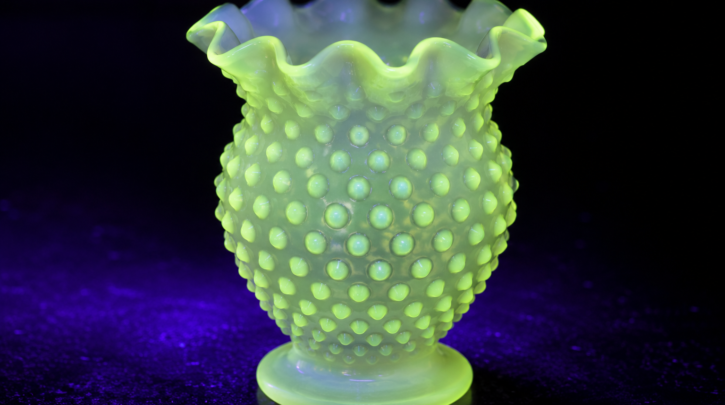
Victorian-era milk glass, roughly 1870s through the 1890s, tends toward elaborate decorative forms — vases, compotes, covered dishes — often with more intricate detail work. The far larger wave most collectors actually encounter is the mid-20th-century revival, roughly the 1950s and 1960s, when milk glass became enormously popular for home decor, led heavily by Fenton’s Hobnail pattern; see our makers and history guide for how these two boom periods differed.
Checking Opacity and Weight
Genuine period milk glass typically shows a specific quality of opacity — not perfectly flat white but with subtle depth, and sometimes a faint tint visible when held up to strong light — that’s difficult to fully replicate in cheaper modern reproductions. Weight and mold-seam sharpness matter here just as they do in other collectible glass categories, with crisp, well-defined pattern detail generally indicating an earlier, higher-quality production run.
The UV Blacklight Test
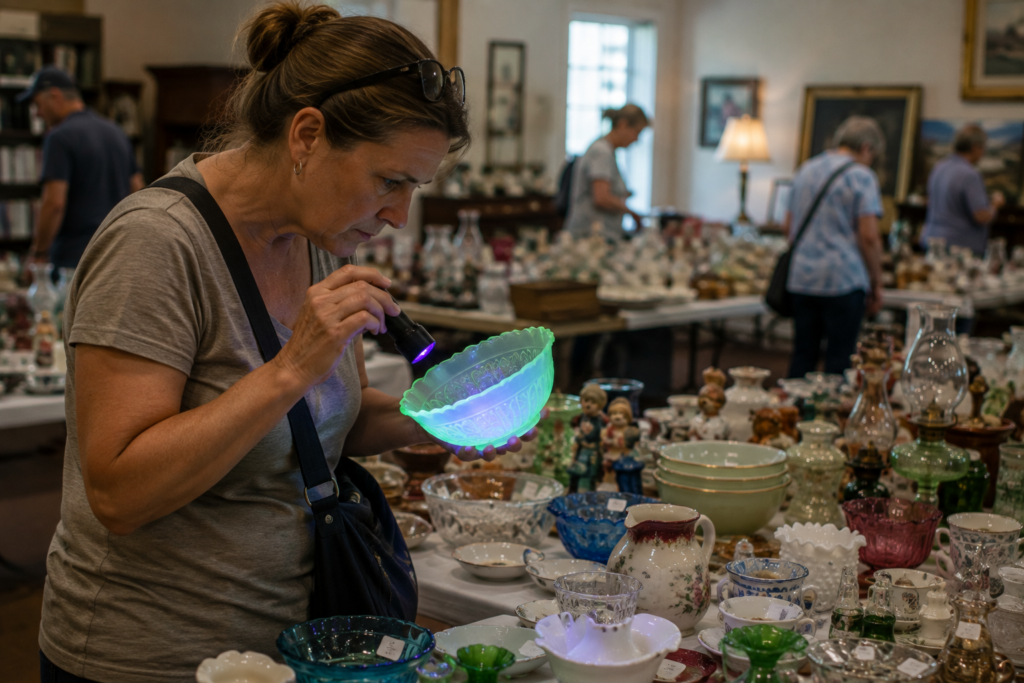
A genuinely useful, if not universally reliable, dating tool for milk glass involves shining a UV blacklight on a piece: older glass, particularly pieces made before manganese was largely phased out of glass formulas around World War II, often fluoresces with a faint yellow-green glow under UV light. This is a different mechanism entirely from uranium glass, which contains actual uranium oxide and glows a much brighter, more consistent green regardless of age; see our uranium and vaseline glass guide for that related but genuinely distinct phenomenon.
Why the UV Test Isn’t Foolproof
Not every piece of genuinely old milk glass fluoresces under UV light, and not every non-glowing piece is automatically modern — manganese content varied by manufacturer, formula, and batch, so the test is a useful supporting data point rather than a definitive verdict on its own. Treat a positive glow as good supporting evidence for age, but don’t treat the absence of a glow as proof a piece is reproduction.
The Reproduction Challenge
Milk glass has been reproduced heavily and continuously for decades, particularly Hobnail pieces and covered animal dishes, which is genuinely complicated by the fact that some of the same companies that made the original popular pieces kept producing similar items for years afterward — this isn’t always a case of an unrelated company faking someone else’s design, but ongoing legitimate production that still affects value; see our patterns guide for the specific forms where this overlap comes up most.
Building a Reliable Eye
As with every category on this site, handling verified genuine pieces alongside known reproductions — at shows, in shops, or through a collector club — teaches the tactile and visual differences far more effectively than any single description can; see our general antique glass identification guide for techniques that apply across every category on this site.
Where Milk Glass Turns Up Today
Estate sales, inherited collections, and antique malls remain the most common sources, and milk glass in particular shows up often in general home-goods sections of thrift stores, since its mid-century popularity means genuine pieces are still relatively common in everyday circulation; see our buying guide for what to expect across different sourcing options.
A Practical First Step
Because Hobnail is both the most common pattern and the easiest to recognize on sight, it’s a reasonable starting point for a new collector to build identification confidence before moving into trickier territory like covered animal dishes, where the reproduction question is genuinely harder to resolve with confidence.
Comparing to a Verified Reference
Serious milk glass collectors typically build a personal reference of verified original photos and pattern details, either through dedicated price guides or collector club resources, and lean on that reference whenever a new piece raises a question — exactly the same approach that pays off in every other collectible glass category covered on this site.
Trusting the Process Over Time
It’s normal to feel uncertain about milk glass identification early on, especially given how heavily some forms have been reproduced — that uncertainty fades with repeated exposure to genuine pieces, and most collectors look back on their first few purchases with a more critical eye than they had at the time, which is simply part of the normal learning curve rather than a sign anything went wrong.