
Fenton produced glass for more than a century across an enormous range of patterns and colors, which means the vast majority of pieces in circulation today are common and genuinely affordable — real value concentrates in specific signature lines, rarer colors, and pieces in excellent condition.
Signature Lines Command Premiums
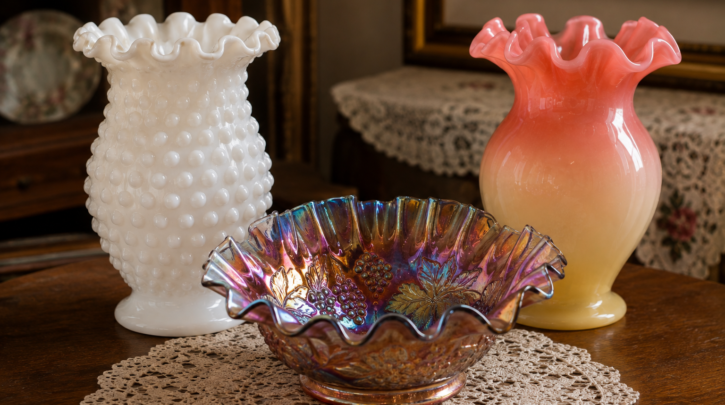
Burmese, cranberry opalescent, and other historically significant, labor-intensive art glass lines generally command stronger prices than common Hobnail pieces, reflecting both their more difficult production process and their smaller relative output; see our colors and patterns guide for the full range of these specialty lines.
Era and the Unmarked Question
Because so much early Fenton left the factory unmarked, confidently dated pre-1970 pieces in well-documented patterns can carry a premium over unremarkable later production, precisely because confirming that earlier date took real identification skill rather than simply reading a mark; see our marks and logos guide for how that dating process works in practice.
Condition Matters Especially for Ruffled Edges
Patterns with crimped or ruffled edges, like Silver Crest, are particularly prone to chipping along that delicate rim, and collectors are generally unforgiving about this kind of damage — a piece with even minor edge chipping typically sells for meaningfully less than the same piece in pristine condition.
Limited Editions and Special Commissions
Fenton produced numerous limited-edition and special-commission pieces over the decades, including runs made for television shopping networks and specific retail partners, and these carry mixed collector value depending on how genuinely limited the run actually was — some “limited edition” pieces were produced in large enough quantities that they haven’t appreciated the way a truly scarce piece would, which is worth keeping in mind rather than assuming every limited-edition label guarantees strong value.
Checking Current Prices
As with every category on this site, checking recent completed sales gives a far more accurate current picture than an older printed price guide.
Check current Fenton glass listings and completed sales Search Fenton glass on eBay
Finding a Match for an Existing Set
Because Fenton produced so many patterns continuously over such a long period, finding a specific piece to complete or replace part of an existing set is a genuinely common need — a specialist replacement retailer with a large cataloged inventory of patterns is often more useful for this specific task than a general marketplace search.
Search for a matching Fenton pattern Search Fenton patterns at Replacements, Ltd.
When to Get a Professional Opinion
For a piece that seems like it could be genuinely early, a true Burmese or slag glass rarity, or part of a documented limited run, a professional appraisal is worth the cost before selling or insuring it; see our appraisal guide for how that process works.
A Broad Collection Can Still Have Standout Pieces
Given how much Fenton was produced across so many years, an inherited or long-accumulated collection often contains a large base of common, modestly valued pieces alongside one or two genuinely notable items — an early unmarked piece, a Burmese rarity, or a piece from a well-documented limited run — worth identifying and researching separately from the rest.
Value Isn’t the Only Reason to Appreciate Fenton
Given Fenton’s genuine historical significance across nearly every American collectible glass category, even a modest, common collection represents a real piece of 20th-century American manufacturing history — worth appreciating on its own terms regardless of what any individual piece happens to be worth on the current market.
A Grounded Approach to Assessing a Fenton Collection
Start by sorting pieces into the categories covered across this site’s Fenton guides — Hobnail, carnival, and the various signature art glass lines — then check marks where present and research the pieces that stand out as unusual, rather than trying to price every single item with equal effort. This targeted approach reflects how the value in most real collections is actually distributed, concentrated in a few standout pieces rather than spread evenly across everything.
That focus saves time and directs research effort toward the pieces actually worth the extra attention.
For most collections, that means a handful of pieces genuinely worth researching in depth and a much larger number worth simply enjoying for what they are.