
Selling antique glass well comes down to the same groundwork every category guide on this site has already covered — know what you actually have, represent it honestly, and price it against real recent sales rather than wishful thinking. But this category has one documentation edge that’s specific to how the glass itself gets authenticated: for uranium and vaseline glass, a photo taken under a UV blacklight, shown alongside a normal daylight photo, proves a claim that buyers otherwise have no way to verify. That pairing is worth building your whole listing strategy around if you’re selling this kind of piece.
Identify and Research Before You Price Anything
Confirming pattern, maker, color, and approximate era first is the foundation everything else builds on — a piece mispriced because it was misidentified helps no one, whether it’s priced too low and sold for less than it’s worth or priced too high and sits unsold indefinitely; see our general identification guide for the framework that applies across every category covered on this site.
Clean Gently Before Photographing
A gentle hand wash before listing genuinely helps a piece show well in photos, but resist the urge to attempt any deeper restoration right before a sale — inexpert cleaning or repair attempts can reduce value more than the original condition issue did; see our cleaning guide for the safe, gentle approach that applies across every category.
Photograph Under UV Light: The Seller’s Edge for Uranium Glass
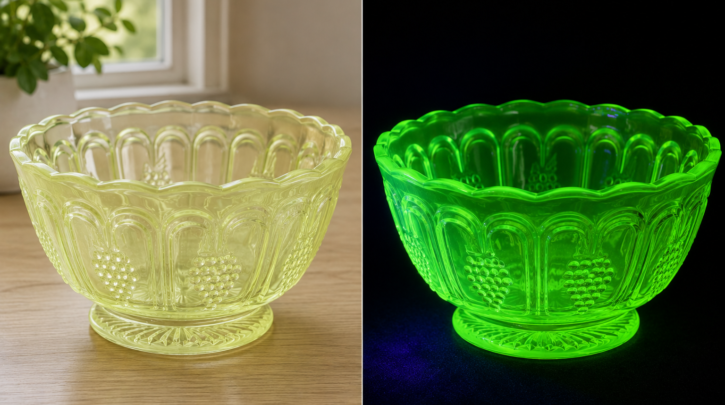
If you’re selling uranium or vaseline glass, this is the single most effective thing you can do to build buyer trust and cut down on disputes after the sale. A daylight photo can only show a piece’s actual color, which is often a pale yellow-green that doesn’t look distinctive on its own. It can’t show the neon-green glow that genuine uranium content produces under a 365nm UV blacklight — and buyers know that. A listing that simply claims “glows under blacklight!” without proof is asking for trust the buyer has no way to verify from a photo alone, which is exactly the kind of gap that leads to return requests and disputed feedback.
The fix is straightforward: take one photo in natural daylight showing the piece’s true color and condition, then a second photo of the same piece under a 365nm blacklight in a darkened room showing the fluorescence directly. Listing both side by side does something a written claim can’t — it lets the buyer verify the authenticity themselves before they ever click buy, rather than taking your word for it and finding out after the box arrives. For a sense of what genuine fluorescence should look like so your photo reads as credible, see our uranium and vaseline glass guide.
A few things make the UV photo itself more convincing:
- Shoot in a genuinely dark room — ambient light washes out the glow and makes the photo look faked or unconvincing even when it’s real.
- Keep the piece in the same position and framing across both photos so a buyer can clearly match the daylight shot to the UV shot.
- Avoid heavy photo editing on the UV shot specifically — an oversaturated glow can read as suspicious to collectors who know what the real thing looks like.
- If you have multiple uranium glass pieces in a listing, photograph them together under the blacklight so buyers can compare intensity, since genuine pieces can vary somewhat in glow strength depending on uranium content.
This same documentation logic — proving what a photo alone can’t — applies more broadly to condition and authenticity claims across the rest of your listing, which is the next thing worth getting right.
Photography That Actually Sells
Natural, indirect light shows true color far better than indoor artificial lighting, and multiple angles — including any maker’s marks, the base, and any damage — give buyers the full picture rather than a single flattering shot. For iridescent categories like carnival glass specifically, a couple of photos from different angles captures the shimmer more honestly than one shot that happens to catch a particularly flattering glint; see our carnival glass colors guide for why lighting matters so much for that category.
Honest Condition Disclosure
Disclosing chips, cracks, repairs, or cloudiness clearly and specifically, rather than using vague language or hoping a buyer won’t notice, protects your reputation as a seller and avoids disputes after a sale — serious collectors specifically appreciate sellers who describe condition precisely, and it builds the kind of trust that leads to repeat business. The same principle that makes a UV photo convincing for uranium glass applies here too: show it, don’t just describe it, whenever you can.
Pricing Against Real Sales
Checking recent completed and sold listings, not just what other sellers are currently asking, gives the most accurate picture of what a piece will actually sell for — asking prices are aspirational and often considerably higher than what buyers actually pay; see our Depression glass value guide and similar category-specific value guides across this site for the factors that drive price in each collecting area.
Check current listings and completed sales for your piece Search antique glass on eBay
Choosing Where to Sell
A common, widely available piece often does best on a general marketplace with the largest possible buyer pool, while a rare or pattern-specific piece can sometimes do better through a specialist channel with a more targeted collector audience; see our buying guide for the flip side of this same landscape from a buyer’s perspective, which applies just as well when deciding where to list.
Shipping Fragile Glass Safely
Double-boxing — wrapping the piece well and placing it inside a smaller box, then centering that box inside a larger one with generous cushioning on all sides — meaningfully reduces breakage risk compared to a single box with minimal padding. Fragile features like Fenton’s ruffled edges or delicate handles deserve extra individual wrapping beyond the general padding around the whole piece.
When a Piece Warrants Extra Care
For anything that seems like it could be a genuinely rare or high-value piece — an unusual color, a scarce pattern, a well-documented rarity — getting a professional appraisal before setting a price is worth the cost, since guessing wrong in either direction on a genuinely valuable piece has real consequences; see our appraisal guide for how that process works.
Writing a Listing That Builds Trust
A detailed, specific listing — exact pattern name, maker if known, precise measurements, and an honest condition description — consistently outperforms a vague one, since serious collectors actively search for specific patterns and skip past listings that don’t clearly identify what’s actually being sold. For uranium glass, mentioning the paired daylight-and-blacklight photos directly in your listing text helps buyers who are scanning quickly understand why those extra photos are there.
Being Patient With Rare Pieces
A genuinely rare or unusual piece sometimes takes longer to find the right buyer than a common one, simply because the pool of interested collectors is smaller — resist the urge to drop the price prematurely on something truly scarce just because it hasn’t sold in the first week or two.
Selling a Whole Collection at Once
For someone liquidating an entire inherited or accumulated collection rather than a few individual pieces, an estate sale company or a dealer offering to buy the full lot outright can be more practical than listing dozens of individual items one at a time, even though the per-piece return is typically lower than patient individual sales would bring.