
Vintage Pyrex patterns range from genuinely common, widely available designs still easy to find at a reasonable price, to a handful of extraordinarily rare test patterns that command serious money whenever a genuine example surfaces.
Primary Colors
The nesting mixing bowl set in yellow, red, green, and blue, commonly referenced by its embossed size numbers 401 through 404, is the most iconic and widely recognized vintage Pyrex product, produced across a long run and remaining relatively accessible for new collectors compared to rarer patterns.
Butterprint (Amish Pattern)
Butterprint, sometimes called the Amish pattern by collectors, features a farm-themed silhouette design — a rooster, wheat, and other rustic imagery — typically in turquoise and white, and it’s one of the more instantly recognizable patterned (rather than solid-color) Pyrex designs.
Snowflake
Snowflake pairs a white snowflake-like design against a solid color background, commonly turquoise, and represents the simpler, more geometric side of Pyrex’s pattern range compared to Butterprint’s detailed pictorial scene.
Gooseberry
Gooseberry shows a scattered white berry-and-leaf motif, most commonly seen on pink or turquoise backgrounds, and it’s another widely produced, relatively accessible pattern that remains popular for its softer, more delicate look.
Spring Blossom (Crazy Daisy)
Spring Blossom, often nicknamed Crazy Daisy by collectors, features a green and white floral pattern and represents Pyrex’s later shift toward brighter, more mod-influenced designs as the line moved through the 1960s and into the 1970s.
The Ultra-Rare Test Patterns
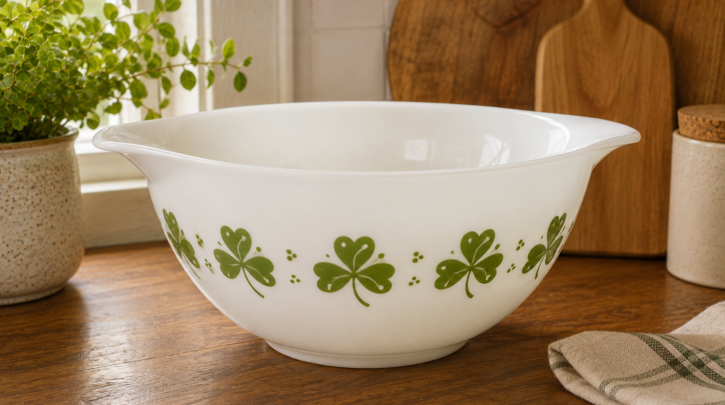
A small handful of patterns were produced in extremely limited quantities, often as internal test runs or promotional items that never reached wide retail distribution, and these command genuinely serious prices whenever a confirmed original surfaces. Lucky in Clover, a four-leaf clover design, is probably the most famous example, along with Pink Stems and Charcoal Stems — all recognized among collectors as sitting in an entirely different rarity tier from anything in regular retail production.
A Quick Rarity Reference
| Pattern | Typical Colors | Relative Rarity |
|---|---|---|
| Primary Colors | Yellow, red, green, blue | Common |
| Butterprint | Turquoise and white | Common to moderate |
| Snowflake | White on turquoise (and others) | Moderate |
| Gooseberry | White on pink or turquoise | Moderate |
| Spring Blossom | Green and white | Moderate |
| Lucky in Clover | Green clover design | Extremely rare |
| Pink Stems / Charcoal Stems | Limited test colors | Extremely rare |
Why Rarity Varies So Much
The huge spread between common patterns like Primary Colors and essentially unobtainable ones like Lucky in Clover comes down almost entirely to original production volume — widely retailed patterns sold for years in large numbers, while test and promotional patterns were made in tiny batches never intended for full-scale sale, which is exactly why so few genuine examples exist today; see our dating guide for how to verify a piece claiming to be one of these rare patterns before paying a premium price.
Regional and Promotional Color Variations
Beyond the named patterns, some pieces exist in color variations that were never part of a pattern’s standard retail run — sometimes regional test-market colors, sometimes promotional one-offs — which adds another layer of rarity beyond pattern name alone. These color variants are genuinely tricky territory even for experienced collectors, since documenting exactly which unusual combinations are authentic requires deep, specialized reference knowledge.
Building a Pattern Reference of Your Own
As you get more familiar with the hobby, keeping your own notes or photos of confirmed genuine patterns — their exact colors, proportions, and typical markings — builds a personal reference that becomes genuinely useful for quickly evaluating new finds, rather than starting from scratch with every unfamiliar piece.
Friendship and Old Orchard
Beyond the patterns above, Friendship and Old Orchard represent two more widely produced designs from Pyrex’s extensive mid-century catalog, each with their own dedicated following — part of what makes vintage Pyrex collecting so sustainable long-term is simply how many distinct patterns exist to discover and pursue beyond the handful of most-recognized names.
Hot Air Balloons and Later Patterns
Pyrex continued introducing new patterns into the 1970s, including designs like Hot Air Balloons that reflect the era’s shifting design sensibilities away from the more traditional florals and farm scenes of earlier decades — a useful reminder that the vintage Pyrex era spans genuine stylistic evolution rather than one consistent look across its entire run.
Learning to place a pattern within this broader timeline adds real context to what might otherwise just be a name and a color combination.